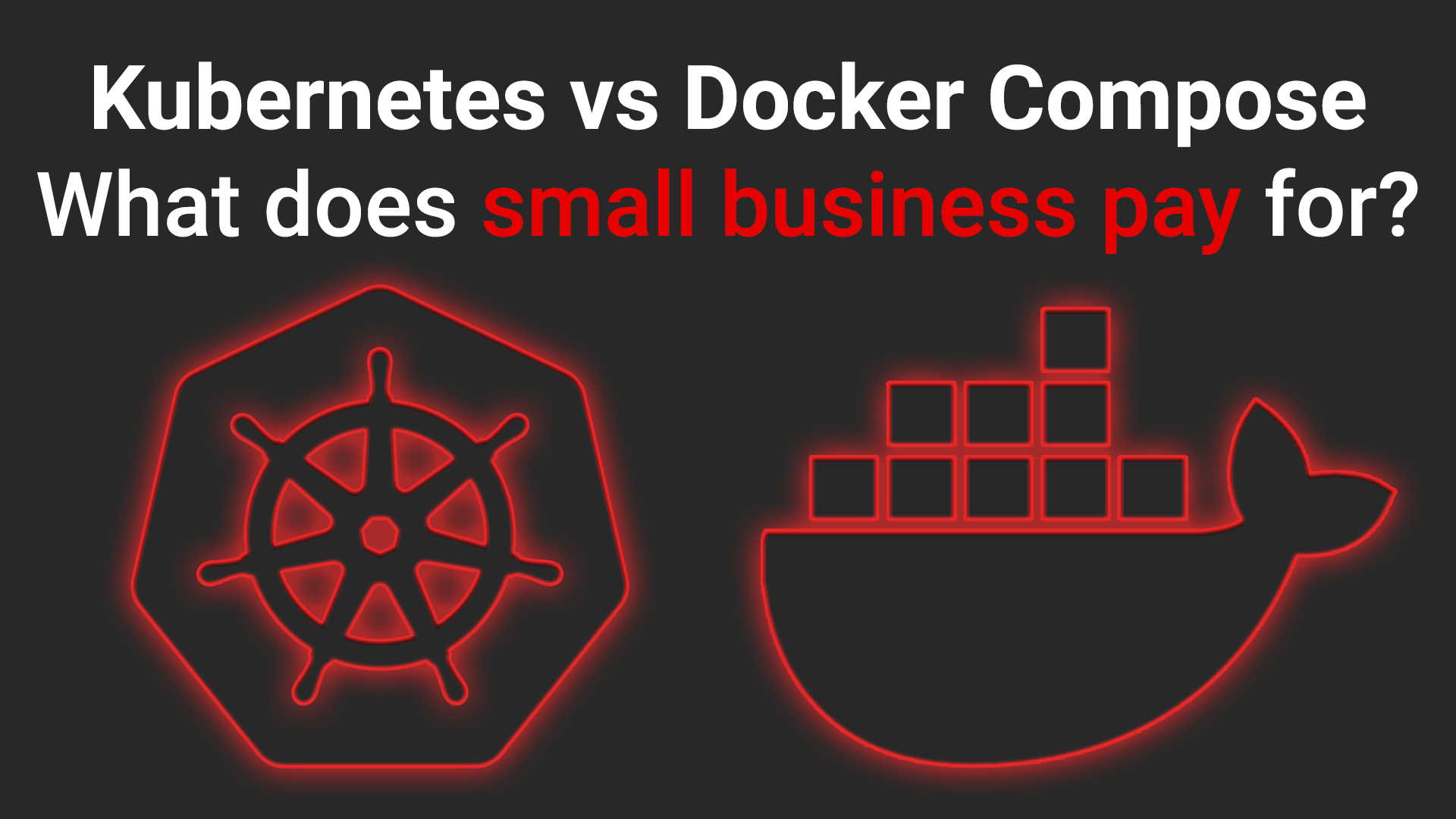
Kubernetes vs Docker Compose: What does small business pay for?
Greetings, friends!
For small companies developing digital products, the abbreviation Kubernetes (K8s) has long been synonymous with a modern, scalable backend. However, behind the flashy status of an industry standard lie technical compromises, a steep learning curve, and hidden operational expenses.
Is it worth for a small business to implement K8s, or will a classic architecture based on Docker Compose / KVM VPS provide a better Return on Investment (ROI)? Let's break down the economics, technical risks, and alternative scenarios.
Key Takeaways: Core Conclusions
Kubernetes is a process orchestrator, not a development accelerator: K8s itself does not make applications faster. It solves problems of automatic scaling, fault tolerance, and configuration management across dozens or hundreds of microservices.
The hidden cost of K8s for small business lies in qualifications and overhead: The operational overhead of running the Control Plane (etcd, API server, Ingress controllers, CNI) and the necessity to hire specialized DevOps engineers often exceed the cost of the server hardware itself, making it unjustifiably expensive for small teams.
A hybrid approach is the best choice to start: For 90% of small projects, an optimized KVM VPS with Docker Compose, properly configured CI/CD, and isolated databases will deliver 99.9% uptime at an infrastructure cost 5–10 times lower than a Kubernetes cluster.
When Kubernetes Becomes a Fiasco for Small Business
The main mistake made by small businesses is attempting to copy the architectural solutions of tech giants (Google, Netflix, Uber) for a project with an audience of just tens of thousands of users. For instance, if you are launching a streaming service, using Kubernetes before you reach a substantial user base (100,000+ users) is logically unsound. Instead of investing in useful tools, you end up buying into Kubernetes, which you simply do not need at this stage.
1. Financial Overhead
A minimum viable fault-tolerant K8s cluster requires:
3 nodes for the Control Plane (to maintain etcd quorum).
A minimum of 2–3 Worker nodes to handle workloads.
Separate Load Balancers and block storage (Persistent Volumes).
As a result, a significant portion of your IT budget is spent not on executing your application's code, but on maintaining the Kubernetes infrastructure itself.
2. Day 2 Operations Complexity
Deploying a cluster using automated scripts is only 5% of the journey. The real difficulties begin during ongoing operations:
Regular K8s version upgrades (every 4 months) with the risk of API breaking changes.
Setting up network connectivity (Calico, Cilium, Flannel) and SSL certificates (Cert-Manager).
Collecting logs and metrics (Prometheus, Grafana, Loki), which consume dedicated node resources.
Without an experienced DevOps engineer on staff, any emergency involving etcd or Ingress will lead to prolonged business downtime. Therefore, adopting K8s right away is dangerous rather than helpful, and the topic should be thoroughly studied before making a move.
When Is Kubernetes Actually Justified?
Despite the complexity, there are scenarios where adopting K8s in a small business is economically and technically justified:
Dynamic Horizontal Pod Autoscaling (HPA): If your service faces sharp traffic spikes (e.g., e-commerce during sales or event ticketing platforms), K8s allows you to scale up dozens of container replicas in seconds and scale them back down when traffic subsides.
Multi-Cloud / Hybrid Strategy: K8s abstracts the application from the underlying hardware vendor. You can easily migrate workloads between providers or on-premises data centers without rewriting deployment scripts.
Multi-Stream Development in Large Teams: If 5 or more independent teams work on the product, K8s provides convenient environment isolation (Namespaces), resource limits (Resource Quotas), and standardized deployments via Helm charts.
Comparison Matrix: Kubernetes vs KVM VPS + Docker Compose
| Evaluation Criterion | Kubernetes (K8s) | KVM VPS + Docker Compose |
| Barrier to Entry | High (requires deep knowledge of K8s, CNI, storage). | Low (basic knowledge of Linux and Docker is sufficient). |
| Minimum Hardware Costs | High (starting from 3–5 nodes for reliability). | Low (1–2 high-performance VPS are enough). |
| Time-to-Market | Weeks (configuring manifests, CI/CD, ingress). | Hours (simple docker compose up -d). |
| Scalability | Automatic (HPA / Cluster Autoscaler). | Vertical (adding RAM/CPU) or manual Scale-out. |
| Fault Tolerance | Self-healing (Self-healing pods, rescheduling). | Requires external monitoring and container restarts. |
Checklist: Do You Need Kubernetes Right Now?
Ask yourself 4 simple questions before making a decision:
How many microservices are in your system?
Fewer than 10: You do not need Kubernetes. Use Docker Compose or Docker Swarm.
More than 20: K8s can be considered.
What is your monthly infrastructure budget?
Less than $300–$500/mo: K8s is cost-ineffective.
From $1000+/mo: You can allocate a budget for Managed K8s or qualified personnel.
Do you have a dedicated DevOps engineer on staff?
No (handled by a developer): Absolutely not. Developers should write code, not debug CNI networks at 3 AM.
Yes: K8s is viable.
Is instantaneous Auto-scaling critical?
No (predictable load): A high-quality KVM VPS with fast NVMe drives is sufficient.
FAQ: Frequently Asked Questions
Is Docker Swarm a good alternative to Kubernetes?
Yes. Docker Swarm is significantly simpler to set up and manage, uses standard
docker-compose.ymlsyntax, and requires minimal resource overhead. It serves as an excellent intermediate step between a single VPS and heavy Kubernetes. There is also a vast selection of tutorials available to help you get up to speed quickly.What is Managed Kubernetes, and does it solve the small business problem?
Managed Kubernetes (where the provider handles Control Plane maintenance) reduces the headache of configuring etcd and master nodes. However, managing applications, manifests, Helm charts, logging, and network security still rests on your team's shoulders.
Can I run Kubernetes on a single VPS?
Technically yes (using lightweight distributions like K3s or Minikube). However, a single-node K8s setup loses its core benefit—fault tolerance—while retaining full configuration complexity and memory overhead.
Conclusion
Kubernetes is a powerful tool for solving complex architectural challenges, but for most small businesses, it becomes a source of premature optimization. Investing resources into K8s at an early stage often distracts the team from the main goal—developing the product itself.
The key to high performance and 99.9% service availability at the start is not the complexity of the orchestrator, but the reliability of the underlying hardware foundation and a properly configured server environment.
If you need maximum performance without overpaying or dealing with system overhead, consider NVMe VPS and Cloud Servers from MivoCloud. We provide pure KVM virtualization on modern CPUs, enterprise-grade ultra-fast NVMe storage, and dedicated bandwidth, allowing your Docker or Docker Swarm containers to run at top speed.
Article Author: Anatolie Cohaniuc